Nvidia takes minority stake in powered-land developer Cloverleaf Infrastructure
Nvidia has made a minority investment in Houston-based Cloverleaf Infrastructure, a powered-land developer with more than 7 GW sold and a 10 GW-plus pipeline, as the chipmaker extends its reach upstream.
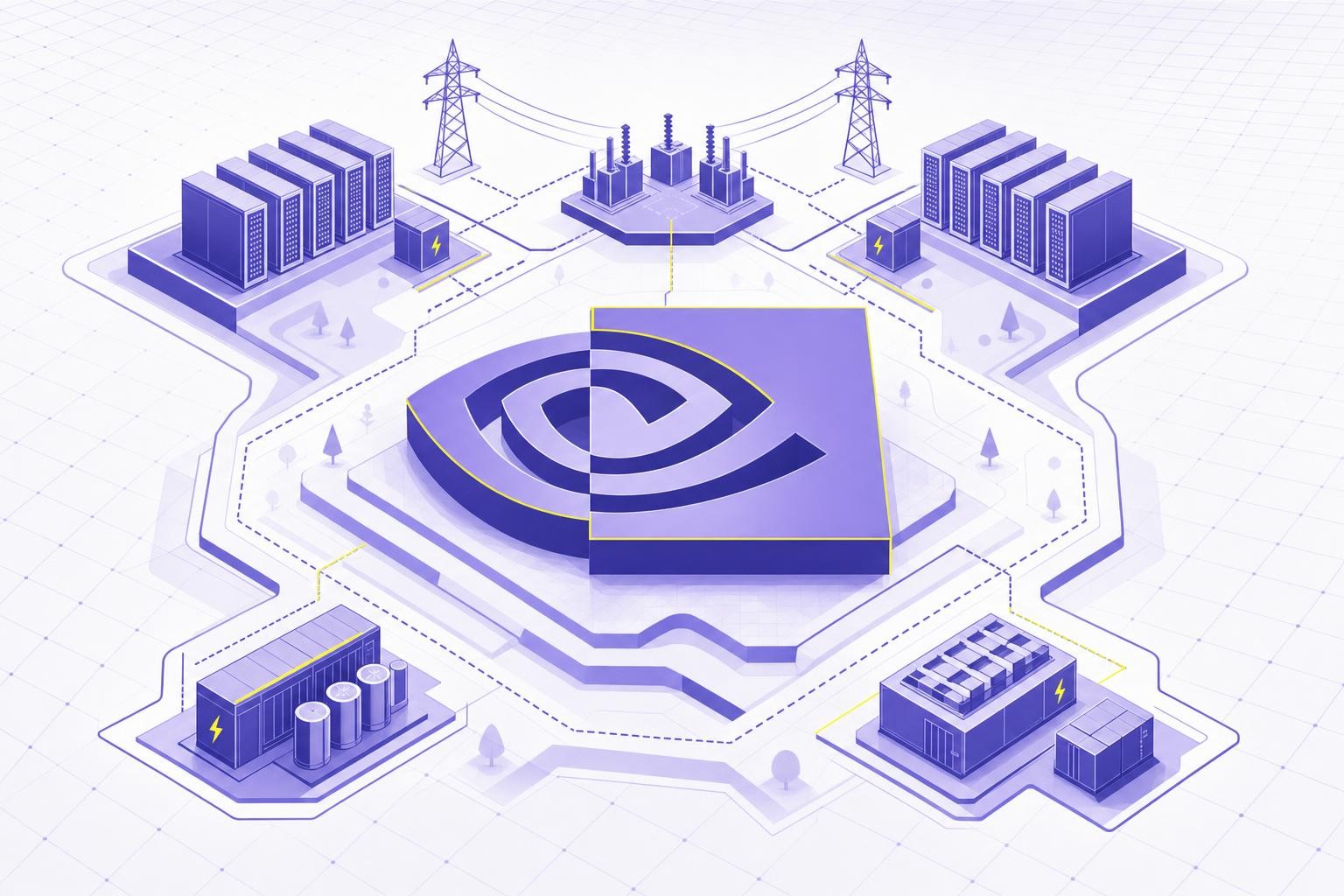
Nvidia has taken a minority stake in Cloverleaf Infrastructure, a Houston-based developer that secures utility agreements and prepares shovel-ready sites for data center operators, the two companies announced on 21 August 2026[1]. Financial terms were not disclosed, though the Wall Street Journal had earlier reported the investment could reach several hundred million dollars. The deal is Nvidia's third major power-infrastructure commitment in recent months, following a reported $2 billion initial stake in Lancium and a $1.5 billion investment in SoftBank's SB Energy[1].
What Cloverleaf does
Cloverleaf was founded in 2024 with $300 million in backing from energy investors NGP Energy Capital and Sandbrook Capital. Its model sits at the upstream end of the data center supply chain: the company signs power agreements with utilities, secures land, and delivers sites to developers before a single rack is designed.
Since its founding, Cloverleaf has sold projects capable of supporting more than 7 GW of data center load to customers across North America, including sites in Wisconsin developed for Oracle and OpenAI[1]. Its forward pipeline exceeds 10 GW[1]. The company had been working with J.P. Morgan Securities on strategic options - including a potential full sale - before settling on the Nvidia minority investment. J.P. Morgan served as exclusive financial adviser to Cloverleaf on the transaction; Kirkland & Ellis acted as legal counsel.
Cloverleaf's business model — locking in utility power agreements before developers commit capital — has become a distinct asset class as grid interconnection queues lengthen and power availability displaces permitting as the primary constraint on data center siting.
How Nvidia's DSX platform fits in
As part of the partnership, Cloverleaf will adopt Nvidia's DSX reference design across its projects[1]. DSX is Nvidia's blueprint for building data centers that integrate its latest CPU-GPU racks, Spectrum-X Ethernet networking, and storage. Cloverleaf will apply the platform to bring site selection, power, cooling, computing, and facility decisions together earlier in the design phase - a shift intended to reduce the iteration cycles that currently slow projects from land acquisition to energisation.
The practical effect is that Nvidia gains a design-level influence over sites before any operator has signed a lease. For Cloverleaf's customers, it means access to Nvidia's full AI factory stack - accelerated computing, high-performance networking, and infrastructure software - from the point of site evaluation rather than after construction begins.
Nvidia's upstream push
The Cloverleaf deal extends a pattern that has accelerated through mid-2026:
- Lancium - Nvidia committed an initial $2 billion for roughly a 20% stake in the Blackstone-backed Texas power developer, with up to $1 billion more contingent on grid-connection milestones.
- SB Energy - Nvidia invested $1.5 billion in SoftBank's data center development arm, which is advancing a large campus in Ohio.
- Cloverleaf - minority stake, undisclosed size, covering the powered-land layer before construction begins.
The logic across all three is consistent: Nvidia's next-generation platforms sell into capacity that does not yet exist, so the company is seeding developers and financing vehicles positioned to build it. A stake in the powered-land layer extends that strategy to the very start of the supply chain.
What to watch
Cloverleaf has faced local opposition in some markets[1], a constraint that has derailed or delayed several large data center projects across the US in 2026. Whether Nvidia's backing - and the DSX design mandate - accelerates project delivery or simply raises the profile of contested sites will be the near-term test. The more consequential question is whether Nvidia's three-pronged infrastructure investment strategy produces measurable reductions in the time between site identification and first power delivery, the metric that now determines competitive position in the AI infrastructure race.
The images and texts on this page were created with the help of AI.
Related
Ready-to-build BESS projects lose their premium as Australia's NEM arbitrage spreads collapse 85%
Panellists at the Battery Asset Management Summit Australia 2026 said the venture-capital-style returns that once rewarded ready-to-build BESS projects have disappeared as NEM price spreads fell 85% in a year.
10 Sept 2026UK government opens three-month consultation on AI for clean energy, backed by 34-recommendation network review
DESNZ published its Vision for an AI-enabled clean energy system on 8 September, opening a call for evidence that closes 6 November and will feed into the UK's first AI for Clean Energy Strategy.
10 Sept 2026Heatwaves expose a three-layer risk for wind operators: resource, hardware, and people
Extreme heat cuts wind output, stresses nacelle components, and grounds maintenance crews - all at once. A look at how bad the summer of 2026 has been, and what the trend means for grid reliability.
10 Sept 2026