PJM's capacity crunch deepens as grid-forming batteries move to mainstream
PJM's 2028/29 auction hits the price cap for a third straight time, short 6.8 GW of its reliability target. Meanwhile, grid-forming BESS crosses from pilot to infrastructure - from Scotland to Munich.
Three stories dominated the Grid & Transmission beat this week. PJM's capacity market produced its third consecutive price-capped result - and a widening reliability shortfall. In Europe, grid-forming battery storage crossed a threshold from demonstration project to commercial infrastructure. And the engineering literature is catching up, reframing what "grid stability" even means in a system dominated by inverter-based resources.
PJM: Three Auctions, Three Price Caps, a Growing Hole
PJM's 2028/29 Base Residual Auction, held July 14, cleared at $325/MW-day across its entire footprint - the FERC-approved price cap - for the third consecutive auction. The nominal price is a 2.5% decline from the prior auction's $333.44/MW-day ceiling, but that arithmetic is misleading: the cap itself was lowered, not the underlying scarcity.
The muted decline is attributable only to a lowered cap rather than any reflection of easing system conditions. PJM's own modelling makes the point plainly: without the cap, the auction would have cleared at $555/MW-day - 71% higher - with ComEd alone separating to $777/MW-day, pushing the total uncapped cost to $29.7 billion against the $16.4 billion buyers will actually pay.
The gap between the administrative cap and the uncapped market price sat 18% above the cap for 2026/27, then 59% above for 2027/28, and is now 71% above. Administrative suppression is widening, not easing.
The reliability picture is equally stark. The auction left PJM with a roughly 6.8 GW shortfall below the grid operator's 20% installed reserve margin target - an increase from the last auction's shortfall of 6.5 GW, its first ever. It also drew only about 525 MW in new resources, including 208 MW of uprates to existing generation, down from 774 MW of new resources in the previous auction.
The cost trajectory for large commercial and industrial customers is severe. Compared with 2024, the monthly capacity charge for a 10-MW industrial customer will likely jump from around $6,000 to roughly $70,000 in 2028.
What the price cap obscures: PJM's cap is set in installed-capacity (ICAP) terms and then divided by the accreditation of the reference resource — a dual-fuel gas turbine — to produce the UCAP clearing price. The reference resource's accreditation rose from 77% to 79% for this auction, mechanically lowering the UCAP cap even as underlying scarcity worsened. The headline 2.5% price decline is a rounding artefact of that methodology, not a market signal.
The Queue Problem and the AI Workaround
The supply shortfall is partly a function of how slowly new generation reaches the grid. There is no longer a backlog of new service requests - all generation projects seeking to connect with the PJM grid are now being actively studied or undergoing preliminary review, with a processing time of one to two years. That is progress from a queue that once stretched to 200 GW with multi-year waits.
PJM has developed internal automation to handle the large number of applications while also working with Google's Tapestry to leverage artificial intelligence to help further streamline the process. Tapestry's HyperQ is an agentic AI tool that reads through interconnection request applications to confirm they meet all related requirements and flags any errors.
The structural critique, however, is that clearing the backlog is not the same as connecting capacity. PJM claims to have "processed" more than 170 GW of new generation project requests since 2023, but most of these projects withdrew, often after waiting years for review - meaning very few projects have come online in the past five years. Analysis by Grid Strategies finds that connecting just 15% more of the projects in the PJM queue would have lowered PJM's 2025/2026 capacity market auction by as much as $7 billion.
Grid-Forming BESS: From Pilot to Infrastructure
The second major story this week is the accelerating commercial deployment of grid-forming battery storage - technology that was still largely theoretical five years ago.
The distinction matters for grid planners. Grid-forming inverters autonomously establish and regulate grid voltage and frequency, providing synthetic inertia and stability support. Unlike grid-following inverters, they can operate without an existing grid reference, enhancing reliability in systems with high levels of variable renewable generation.
Electricity grids need inertia to maintain stability, but the way energy is now generated is making it harder to access. Synchronous generators - the heavy rotating turbines in coal, gas, nuclear and hydropower plants - can provide control room engineers with the inertia needed to maintain frequency. Replace coal with solar and the control room must find inertia somewhere else.
Blackhillock: The Reference Project
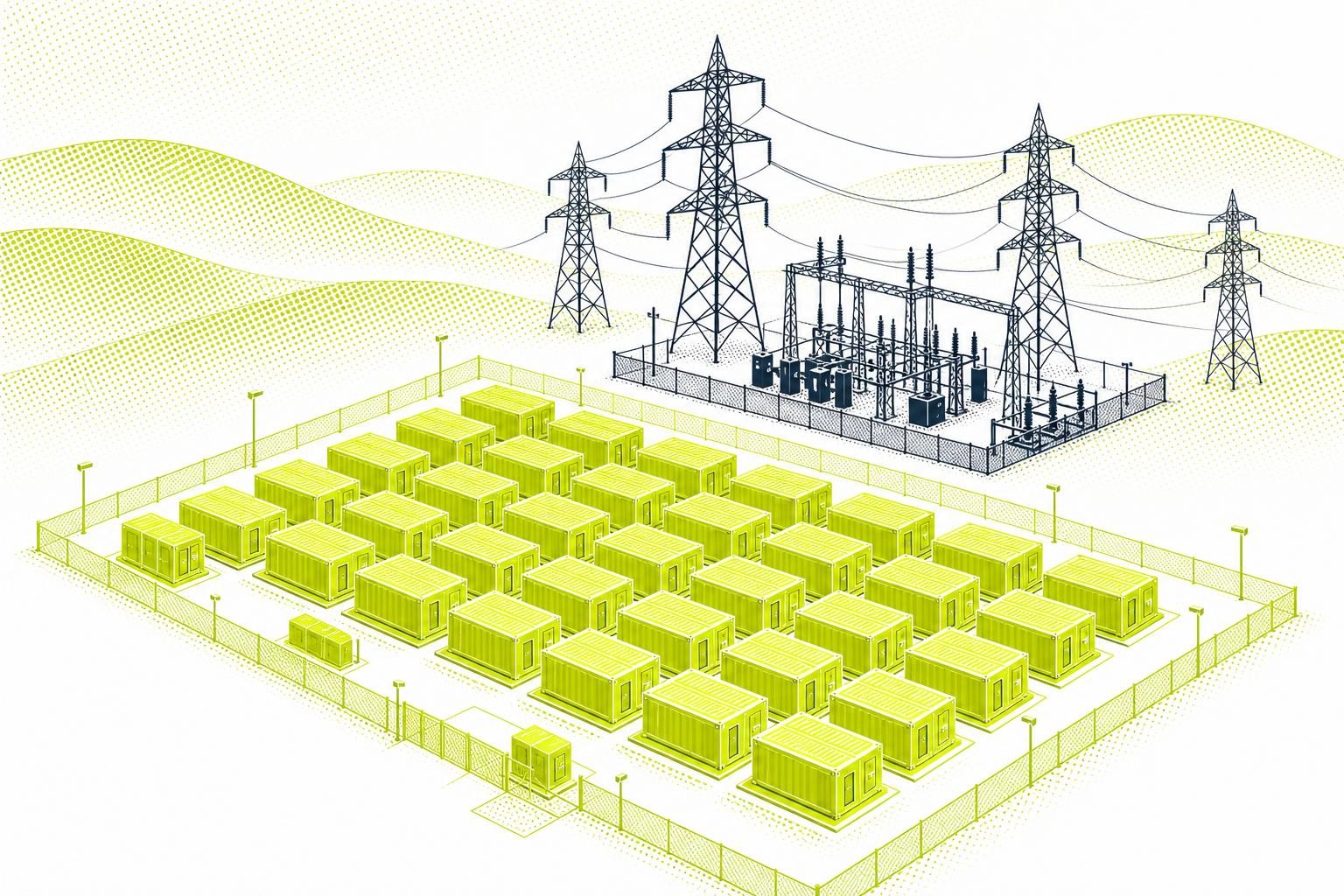
The clearest proof-of-concept is in northeast Scotland. Developed by Zenobe and using energy storage provided by Wärtsilä Energy Storage, the 200 MW/400 MWh phase-one section of Blackhillock BESS was commissioned in early 2025, becoming the first battery in the world to provide full active and reactive power stability services connected to the transmission system.
Blackhillock's grid-forming inverters deliver 370 megawatt-seconds of synthetic inertia and 116 MVA of short-circuit contribution directly to the GB transmission system. The site was deliberately located between Inverness and Aberdeen to address grid congestion caused by nearby offshore wind farms including Viking (443 MW), Moray East (950 MW) and Beatrice (588 MW).
The site uses Wärtsilä's Quantum energy storage system technology and GEMS Digital Energy Platform with SMA grid-forming inverters - a combination that enables the system to provide stability services including short-circuit level and true synthetic inertia, essential for maintaining grid reliability as the UK phases out fossil fuel power plants.
Phase 2, adding a further 100 MW, is underway. A separate 349 MW/748 MWh battery storage project has also secured planning approval in Scotland, while near Liverpool, the first phase of a 142.5 MW/348.5 MWh project has entered commercial operation with a second phase that will add advanced grid-forming capabilities to support regional system stability.
SINEXCEL Brings Grid-Forming to European Utility Scale
The commercial supply chain is also maturing. At Intersolar Europe 2026 in Munich, SINEXCEL launched its StellaON 1250K/1575K power conversion system, explicitly targeting the European utility-scale BESS market. The PCS integrates Infineon's advanced EconoDUAL™3 power modules, enabling 55°C full power operation, grid-forming capability, and 98.5% full load efficiency for utility-scale applications.
The Infineon modules' low thermal resistance enables continuous output at 55°C - 10 degrees above the industry norm - while eliminating 15 to 20 percent power derating and reducing oversizing costs by up to 20 percent. The unit features an IP65 enclosure and a C5 anti-corrosion rating, allowing operation in extreme climates while keeping noise levels as low as 65 dB to comply with strict European urban permitting requirements.
SINEXCEL's StellaON secured more than 500 MW of orders in the first half of 2026, with over 15 projects under deployment across Europe, Asia-Pacific, and Africa. The platform is certified for Germany, Poland, the Netherlands, Belgium, and Romania, with Spain and U.S. approvals expected soon. The strongest utility-scale demand is currently in Eastern Europe, where those markets are growing fast for utility-scale storage.
For project execution, SINEXCEL signed a milestone agreement with Tesla Energy Holding, a Czech assembly and integrator of BESS, to execute utility-scale BESS projects.
The Engineering Shift: Systems, Not Assets
Underlying both stories is a structural change in how grid engineers think about their work. The traditional model - generation, transmission, and ancillary services as separate optimisation problems - is giving way to integrated system design.
BESS equipped with grid-forming inverters based on virtual synchronous machine (VSM) controllers can enable synthetic inertia, voltage regulation, and frequency support simultaneously. Research published in June 2026 simulating a 100 MW solar PV plant paired with a 35 MW/60 MWh grid-forming BESS found that in all tested scenarios, the grid-forming control provided immediate active and reactive support - including under weak-grid conditions with short-circuit ratios as low as 0.42.
The regulatory framework is catching up. MISO finalised grid-forming requirements for new BESS interconnection in November 2024. Europe announced a 1 MW+ grid-forming rule for 2026. Australia's AEMO has made grid-forming the de facto standard for new large-scale BESS.
The grid-forming inverter market was valued at $788.5 million in 2024 and is projected to reach $1.58 billion by 2032, at a compound annual growth rate of approximately 9.1%.
For PJM planners, the implication is direct: the interconnection queue reforms and AI-assisted study timelines matter only if the projects that clear the queue are the right kind of projects - ones that contribute not just megawatts but the stability services a high-renewables grid requires. The capacity auction results show the megawatt gap. The grid-forming deployment curve suggests the technology to close it is no longer experimental.
Machine-drafted · Editor-reviewed. Primary sources: PJM Interconnection 2028/29 Base Residual Auction results (July 14, 2026); Modo Energy auction analysis (July 2026); Zenobe/Wärtsilä Blackhillock commissioning announcement (March 2025); SINEXCEL StellaON launch press release, Intersolar Europe 2026 (July 6, 2026); PV Magazine grid-forming BESS stability research (June 2026); INL GridTechPedia grid-forming inverter entry (June 2026).
Related
Fusion hits a record $4.48bn funding year as China keeps building
Four stories shaping the global nuclear sector this month: a record $4.48bn fusion funding year, China's relentless reactor pipeline, the UK's £2.5bn fusion strategy, and Rosatom completing its VVER accident-tolerant fuel pilot.
30 Jul 2026The grid can't keep up: how data centres became the power sector's defining problem
PJM Interconnection's 2028/2029 Base Residual Auction cleared at the FERC-mandated $325/MW-day cap on July 14, 2026, leaving a 6.8 GW reliability shortfall. The price signal has hit its ceiling; PJM is now managing scarcity through administrative tools.
30 Jul 2026